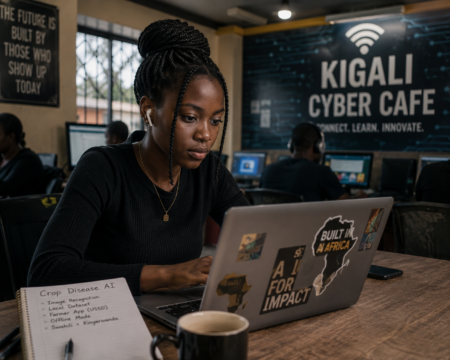
Africa’s young people won’t be remembered as the generation that encountered artificial intelligence. They will be remembered as the generation that decided what Africa would do with it.
Across Nairobi, Lagos, Accra, and Kigali, a new kind of technologist is emerging — not importing tools built for Silicon Valley problems, but building AI systems trained on African languages, African datasets, and African realities.
The infrastructure gap is closing
Five years ago, the conversation about AI in Africa was mostly about access — who had the bandwidth, the devices, the electricity to participate. That conversation has not ended, but it has been joined by a new one: what do we build, and for whom?
The question is no longer whether Africa will participate in the AI revolution. The question is whether it will lead parts of it.
Language is the frontier
The most significant gap in current AI systems is linguistic. The large language models powering everything from chatbots to medical diagnosis tools were trained overwhelmingly on English-language data. Swahili, Hausa, Yoruba, Amharic, Zulu — the languages spoken by hundreds of millions of Africans — are almost entirely absent. A consortium of African universities is assembling the Pan-African Language Corpus to address this.
What this means for everyday Africans
Farmers who cannot read could receive AI-generated advice in the language they speak at home. Patients in rural clinics could describe symptoms to a nurse using an AI diagnostic tool trained on African disease patterns. Small business owners could access credit through AI systems that understand informal economy paperwork.
Image: Stori.
Join the conversation
0 commentsWhat do you think? Keep it civil, keep it curious.
Leave a comment