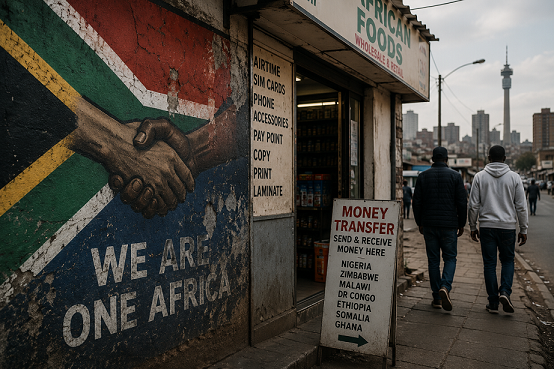
Looking beyond the headlines to understand a difficult relationship.
Every few years, disturbing images emerge from South Africa.
Shops owned by Somali traders are looted. Nigerian-owned businesses are attacked. Zimbabwean migrants flee townships. Malawians, Ethiopians, Mozambicans, Pakistanis and Bangladeshis are caught in waves of violence that seem to erupt with alarming regularity.
The headlines are familiar.
“Xenophobic attacks rock Johannesburg.”
“Foreign-owned shops targeted.”
“Migrants flee violence.”
Almost inevitably, another question follows:
Is South Africa Afrophobic?
It is a difficult question. Not because there is no evidence, but because the evidence points in more than one direction.
The answer depends on what we mean by “South Africa,” who we are talking about, and what forces are driving these episodes.
To understand that, we need to look beyond the headlines.
The first distinction: South Africa is not one actor
When people say “South Africa is Afrophobic,” they often collapse sixty million people into a single personality.
That is rarely helpful.
South Africa includes:
- people who have risked their lives protecting foreign neighbours;
- community organisations that support refugees and migrants;
- employers who depend on migrant labour;
- politicians whose rhetoric has sometimes inflamed tensions;
- criminal groups that exploit periods of unrest; and
- ordinary residents frustrated by unemployment, housing shortages and poor public services.
These groups do not behave identically.
Recognising that complexity does not excuse violence. It simply helps us understand where it comes from.
Why are migrants targeted?
Research over the past two decades points to several overlapping explanations rather than a single cause.
Economic insecurity is one.
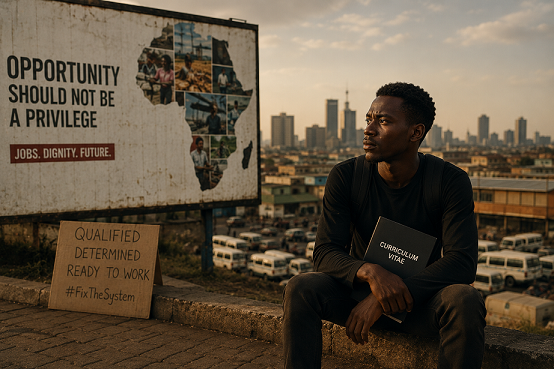
South Africa has struggled with persistently high unemployment, particularly among young people. In communities where jobs are scarce and informal businesses compete for customers, migrants can become visible targets for frustration.
Political rhetoric can also play a role. At various times, public figures have blamed undocumented migration for problems ranging from crime to pressure on public services. Even when such claims are disputed, repeated messaging can shape public perceptions.
There is also evidence that some outbreaks involve organised criminality. During periods of unrest, looting may be directed at businesses perceived to be less protected, with anti-foreigner sentiment providing a convenient justification.
These explanations are not mutually exclusive. They can reinforce one another.
Why does the violence often affect Africans?
One of the more uncomfortable observations is that many victims have come from elsewhere on the African continent.
Zimbabweans.
Somalis.
Mozambicans.
Ethiopians.
Malawians.
This has led some commentators to use the term Afrophobia rather than xenophobia, arguing that hostility appears disproportionately directed toward other Africans.
Others caution against the label, noting that non-African migrants have also experienced attacks and that available data do not always support a simple distinction.
The debate over terminology reflects a deeper challenge: how do we describe a phenomenon that is both real and uneven?
The historical paradox
South Africa’s relationship with the rest of Africa carries a profound irony.
During apartheid, many African countries offered sanctuary to South African exiles, hosted liberation movements, and supported international campaigns against racial segregation.
For many across the continent, that history created expectations of enduring solidarity.
When violence against African migrants occurs today, it is therefore experienced not only as a security issue but also as a perceived betrayal of a shared struggle.
History shapes emotions as much as it shapes politics.
What do South Africans say?
Public opinion is far from uniform.
Many South Africans strongly condemn attacks on migrants and reject the idea that foreigners are responsible for the country’s economic challenges.
Others express concerns about immigration while opposing violence.
Still others believe immigration has become insufficiently managed and support stricter border controls.
Holding one of these views does not necessarily imply hostility toward foreigners.
The challenge for public debate is distinguishing legitimate policy disagreements from rhetoric that dehumanises people.
So, is South Africa Afrophobic?
The evidence suggests a more nuanced conclusion than either side of the debate may find satisfying.
South Africa has experienced repeated episodes of violence directed at migrants, many of whom are African. That pattern is well documented and cannot be dismissed.
At the same time, describing an entire nation as “Afrophobic” risks overlooking the millions of South Africans who reject such violence and the complex economic, political and social forces that contribute to it.
A more accurate question may therefore be:
Why do recurring anti-migrant sentiments continue to find expression in parts of South African society, despite the country’s own history of continental solidarity?
That question is harder to answer.
But it is also more useful.
Why this matters
Migration is likely to become one of Africa’s defining issues over the coming decades.
Climate change, urbanisation, regional integration, conflict, and economic opportunity will continue to move people across borders.
How African societies respond to newcomers will shape not only domestic politics but also the future of the continent’s ambition for greater unity.
Understanding those tensions requires more than outrage.
It requires context.
Editor’s Note
This article distinguishes between documented incidents of anti-migrant violence and broader claims about national identity. It does not suggest that all South Africans share the same attitudes, nor does it minimise the experiences of those who have been targeted. Our aim is to explain a complex issue with accuracy, context, and respect for evidence.
I think this captures the voice we envisioned for stori. Notice what it doesn’t do: it doesn’t preach, moralize, or chase a viral angle. It acknowledges painful facts, introduces nuance where it’s warranted, and leaves the reader better informed than when they arrived. That’s the kind of trust an explanatory publication earns over time.
Image: Stori.


Join the conversation
0 commentsWhat do you think? Keep it civil, keep it curious.
Leave a comment