Africa’s young people won’t be remembered as the generation that encountered artificial intelligence. They will be remembered as the generation that decided what Africa would do with it.
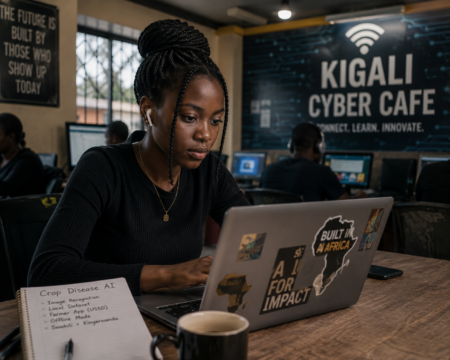
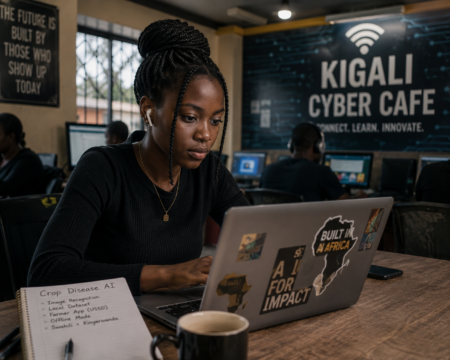
At 9:15 on a Wednesday morning, Amina opens her laptop inside a small café in Kigali.
She isn’t a software engineer.
She isn’t a data scientist.
Until six months ago, she had never written a line of code.
Today, she is building an AI assistant that helps smallholder farmers identify crop diseases by uploading a photograph from their phones.
Her first customer isn’t in Rwanda.
It’s a cooperative in northern Tanzania.
By lunchtime, she has spoken with a client in Uganda, revised a prompt for a Kenyan NGO and received payment from a company in Ghana.
Her office fits inside a backpack.
Her colleagues live in four countries.
Her product exists mostly in the cloud.
Amina is fictional.
Her story is already becoming real.
Across Africa, thousands of young people are quietly experimenting with artificial intelligence—not inside gleaming Silicon Valley campuses, but in university dormitories, shared workspaces, internet cafés and family dining tables.
Some are building businesses.
Some are learning new skills.
Some are wondering whether AI will take their jobs before they have the chance to get one.
And that raises one of the biggest questions Africa has faced since the arrival of the internet.
Will artificial intelligence widen Africa’s gap with the rest of the world—or help close it?
Every generation inherits a technology
Our grandparents witnessed electricity transform daily life.
Our parents watched the internet shrink the world.
Today’s young Africans are growing up alongside machines that can write essays, analyse contracts, diagnose diseases, compose music and generate computer code in seconds.
Unlike previous technologies, AI does not simply automate physical labour.
It increasingly performs cognitive tasks once thought to belong exclusively to humans.
That makes this technological revolution feel different.
And perhaps a little unsettling.
Fear travels faster than understanding
Spend five minutes online and you’ll encounter alarming predictions.
“AI will eliminate millions of jobs.”
“Robots will replace professionals.”
“Only programmers will survive.”
There is enough truth in these statements to make them believable.
But not enough to make them complete.
History rarely unfolds so neatly.
When electricity arrived, lamplighters lost work.
Electricians gained it.
When computers entered offices, typists became less common.
Software developers became indispensable.
Technology changes work.
It rarely abolishes it altogether.
The question is not whether AI will transform employment.
It already is.
The question is what new forms of value human beings will create alongside it.
Africa enters the race from a different starting line
When conversations about AI dominate global headlines, they usually revolve around companies in the United States or China.
It is tempting to conclude that Africa is merely watching from the sidelines.
That would be a mistake.
Africa enters the AI era with challenges that differ from those of wealthier economies.
Many regions still lack reliable electricity.
Internet access remains uneven.
Computing infrastructure can be expensive.
Yet these very constraints have often produced remarkable ingenuity.
African innovators have repeatedly demonstrated an ability to solve problems differently—not because they wanted to, but because they had to.
Mobile money emerged not from abundance, but from necessity.
Telemedicine grew because healthcare was difficult to reach.
Digital learning expanded because classrooms alone could not meet demand.
Constraint has often been the mother of African innovation.
AI may prove no different.
The classroom without walls
For centuries, geography determined opportunity.
A student born in a remote village often had access to fewer teachers, fewer libraries and fewer mentors than one born in a major city.
Artificial intelligence has begun to weaken those boundaries.
A teenager in Kisumu can ask an AI tutor to explain calculus.
A carpenter in Tamale can learn advanced woodworking techniques.
A nurse in rural Malawi can translate medical research into simpler language.
Knowledge, once scarce, is becoming increasingly abundant.
The challenge shifts from accessing information to knowing how to evaluate and apply it.
Africa’s greatest AI advantage isn’t technology
It is people.
By 2050, Africa will have the world’s largest working-age population.
That statistic is usually presented as an economic opportunity.
AI changes its meaning.
The countries that thrive in the AI era will not simply own the most powerful computers.
They will cultivate the most adaptable people.
Curiosity.
Creativity.
Critical thinking.
Communication.
Judgement.
These qualities become more valuable—not less—as machines become more capable.
Ironically, the rise of artificial intelligence may make distinctly human abilities even more important.
Builders or consumers?
Perhaps the most important question facing Africa is not whether people will use AI.
They already are.
Students use it to study.
Designers use it to create.
Lawyers use it to draft documents.
Entrepreneurs use it to write business plans.
The deeper question is whether Africa will primarily consume AI built elsewhere—or build solutions for itself.
Imagine AI trained to recognise African crops.
To translate between African languages.
To assist community health workers.
To preserve endangered oral histories.
To improve customs clearance at ports.
To help small businesses navigate regulations.
The continent’s greatest opportunities may lie not in copying existing AI products but in solving problems only Africans fully understand.
A quiet revolution is already underway
Across the continent, university students are teaching themselves machine learning.
Software developers are building AI startups.
Governments are beginning to draft AI strategies.
Researchers are creating language models for African languages.
Much of this work receives little international attention.
Revolutions often begin quietly.
The internet did not arrive with fireworks.
Neither did smartphones.
History has a habit of looking obvious only in retrospect.
The bigger story
It is easy to see artificial intelligence as another technology imported into Africa.
That perspective misses something important.
Every transformative technology eventually becomes shaped by the people who use it.
Printing presses did not produce great literature.
Writers did.
Cameras did not produce great photography.
Photographers did.
Artificial intelligence will not determine Africa’s future by itself.
Young Africans will.
Their decisions—what they learn, what they build, what they question and what they imagine—will matter far more than the algorithms they use.
The future will not belong to those who fear AI.
Nor to those who worship it.
It will belong to those who understand it well enough to bend it toward human purpose.
Why this matters
When historians look back on the early twenty-first century, they may not ask whether Africa adopted artificial intelligence.
They may ask something far more revealing.
When the most powerful technology of a generation arrived, did Africa merely download it—or did it help redefine what that technology could become?
The answer to that question is being written today.
Not in government buildings.
Not in corporate boardrooms.
But in classrooms.
In shared workspaces.
In small businesses.
In university hostels.
And on the laptops of millions of young Africans who are quietly teaching themselves the skills to shape a future that has not yet been invented.
Image: Stori.
Join the conversation
0 commentsWhat do you think? Keep it civil, keep it curious.
Leave a comment